


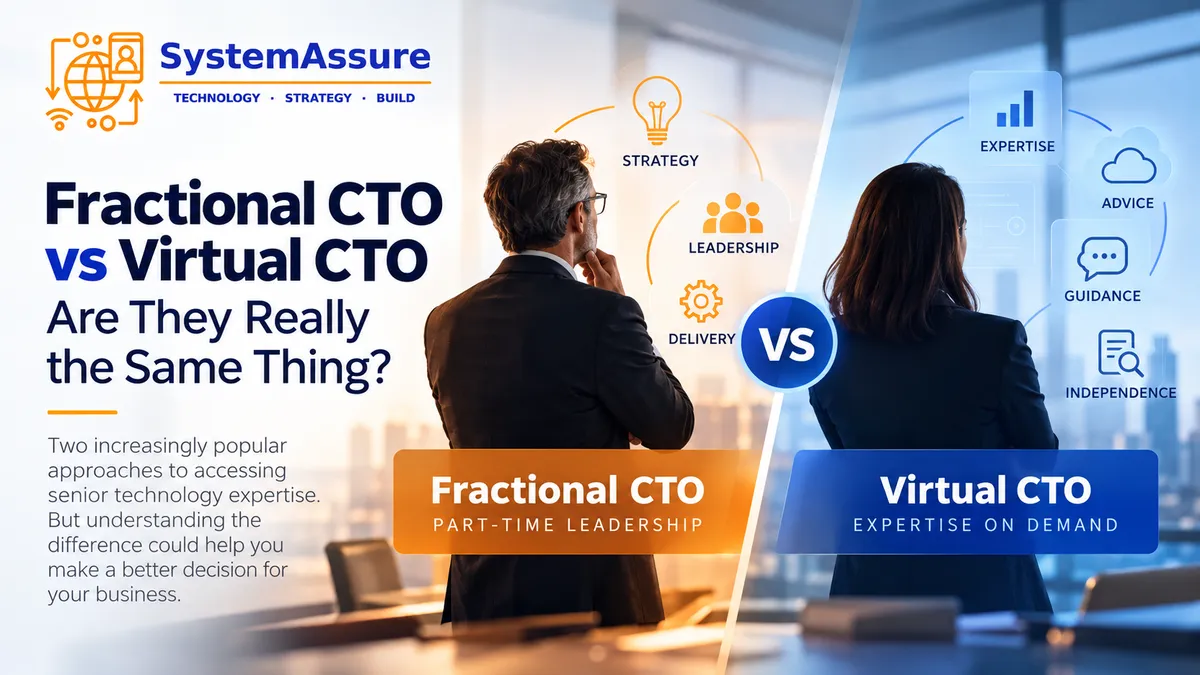
Fractional CTO vs Virtual CTO: Are They Really the Same Thing?
Fractional CTO vs Virtual CTO: Are They Really the Same Thing?
Two increasingly popular approaches to accessing senior technology expertise. But understanding the difference could help you make a better decision about what your business actually needs.
For many organisations, technology has become too important to manage without experienced leadership, but not every business needs, or can justify, a full-time Chief Technology Officer.
This has led to growing interest in alternative arrangements, particularly Fractional CTO and Virtual CTO services.
Search for either term and you will find providers offering technology strategy, architecture reviews, supplier management, digital transformation and executive advice. In many cases, the services appear almost identical.
So are Fractional CTO and Virtual CTO simply different names for the same thing?
Sometimes they are. But the more useful distinction is between taking responsibility for technology leadership and providing access to technology expertise.
Understanding that difference matters more than the title on someone's business card.
What is a Fractional CTO?
A Fractional Chief Technology Officer is typically an experienced technology executive who works with an organisation for an agreed proportion of their time.
Rather than employing a full-time CTO, the business secures access to someone who can perform many of the same leadership responsibilities on a part-time basis.
A Fractional CTO may be involved in setting technology strategy, managing development teams, overseeing architecture, prioritising technical investment and making decisions about technology delivery.
The important characteristic is not simply the number of days worked. It is the level of responsibility the individual assumes.
For example, a growing software business might engage a Fractional CTO for two days each week to lead its engineering function, establish development standards, make architectural decisions and help recruit a permanent technology leader.
Although the arrangement is part-time, the individual is effectively operating as a member of the organisation's leadership team.
In some businesses, the Fractional CTO may have direct responsibility for people, budgets and technology outcomes.
In others, the role may be more advisory. The precise responsibilities depend on the agreement.
What is a Virtual CTO?
A Virtual CTO is generally a service that provides access to senior technology expertise without employing a traditional, full-time CTO.
The term virtual originally suggested that the service was delivered remotely, but physical location is no longer a particularly useful distinction. Both Fractional and Virtual CTOs may work remotely, attend board meetings or spend time on site.
Virtual CTO services can cover a broad range of activities, including technology planning, architecture, cybersecurity oversight, supplier evaluation, investment decisions and strategic advice.
However, the way the service is delivered can vary considerably.
Some providers offer a named executive who effectively performs the same responsibilities as a Fractional CTO.
Others provide access to a team of specialists, with the Virtual CTO acting as a senior adviser or coordinating point of contact.
Managed Service Providers (MSPs) also frequently use the term vCTO to describe strategic technology planning services delivered alongside their operational IT support.
These arrangements can be valuable, but they are not necessarily equivalent to appointing someone to lead the organisation's technology function.
A Virtual CTO might recommend a technology strategy without being responsible for implementing it. Equally, a different provider might assume direct accountability for its execution.
The title alone tells you very little about the actual service being provided.
Fractional CTO vs Virtual CTO: The practical differences
Although the services overlap, there are some common differences in how they are positioned and delivered.
Consideration | Fractional CTO | Virtual CTO |
|---|---|---|
Primary emphasis | Part-time executive leadership | Externally delivered CTO expertise |
Typical engagement | Agreed days or ongoing commitment | Retainer, subscription or agreed commitment |
Leadership involvement | Often embedded in the management team | Ranges from advisory to embedded leadership |
Decision-making authority | May have delegated executive authority | Depends on the service agreement |
Team management | May directly manage technology teams | May advise or manage teams |
Delivery location | Remote, on-site or hybrid | Usually remote, but not exclusively |
Accountability | Often responsible for defined technology outcomes | May be advisory or responsible for outcomes |
These are tendencies, not formal industry definitions. A Virtual CTO can perform every responsibility shown under Fractional CTO, and vice versa.
The distinction that really matters: Advice or accountability?
Consider two organisations facing similar technology challenges.
The first is a growing SaaS business with a development team, an ambitious product roadmap and no experienced technology executive.
Its immediate challenge is leadership.
Someone needs to make architectural decisions, establish development priorities, manage technical debt and ensure the engineering team delivers against business objectives.
In this situation, an embedded Fractional CTO may be appropriate. The organisation needs someone who is part of its leadership structure and has clearly defined responsibility for technology delivery.
The second organisation is an established professional services business considering a major investment in new technology.
It already has an IT team and external suppliers. What it lacks is the confidence to assess competing proposals, challenge supplier recommendations and understand the implications of its decisions.
It may not need another person managing technology.
It needs experienced, independent advice to help its leadership team make better decisions.
A strategically focused Virtual CTO or independent technology adviser could be the more appropriate solution.
Both organisations need senior technology expertise, but they need it applied in different ways.
The importance of independence
There is another consideration that can be more important than the distinction between Fractional and Virtual CTO services.
Who does the technology adviser actually represent?
Some Virtual CTO services are provided by the same organisation responsible for supplying and managing the client's technology.
There can be considerable advantages to this arrangement. The provider understands the existing environment, has direct access to operational information and can coordinate the implementation of recommendations.
However, the relationship can also create potential conflicts of interest.
If the organisation providing strategic advice also earns revenue from selling software, infrastructure, managed services or implementation projects, how does the client know whether a recommendation represents the best business decision?
That does not mean the advice is necessarily wrong. It means the commercial relationship should be understood.
An independent technology adviser approaches the problem from a different position.
Their responsibility is to help the client evaluate its options, challenge assumptions, assess risks and make informed decisions.
They may recommend retaining an existing supplier, changing technology platforms, delaying investment or deciding that a proposed project is unnecessary.
In some circumstances, the most valuable technology advice is to recommend spending less.
For boards and business leaders making significant technology decisions, that independence can be particularly valuable.
What about a Fractional CIO or Virtual CIO?
There is a related distinction worth understanding: the difference between a CTO and a CIO.
Traditionally, a Chief Technology Officer has been more closely associated with technology architecture, engineering, product development and the technical capabilities that enable an organisation's products and services.
A Chief Information Officer has generally focused on how technology supports the organisation itself, including business systems, information management, operational efficiency, governance and technology investment.
These responsibilities frequently overlap, particularly in smaller businesses.
A technology-led company developing a commercial SaaS platform may have a greater need for CTO expertise.
An established business reviewing its enterprise applications, technology costs, cybersecurity exposure or digital transformation strategy may have a greater need for CIO expertise.
But, once again, the title should not determine the engagement.
An experienced technology leader may have worked across both disciplines, and many business challenges require a combination of skills.
The more important question is whether the individual has the experience to address the organisation's particular circumstances.
When should a business consider each approach?
Consider a Fractional CTO when:
You need continuing executive leadership, have technology teams requiring direction, need someone to take responsibility for a technology roadmap, or are preparing to recruit a permanent CTO.
Consider a Virtual CTO when:
You need access to experienced technology leadership without a full-time appointment, particularly where strategic planning, architecture reviews or periodic decision support can be delivered through a flexible service.
Consider an independent technology adviser when:
You need to challenge a technology proposal, evaluate significant investment, understand technology risk, review supplier performance or provide the board with an independent perspective.
These approaches are not mutually exclusive. An organisation may have a Fractional CTO responsible for technology delivery while also using an independent adviser to review major decisions or provide additional assurance to its board.
Six questions to ask before engaging a CTO service
Rather than beginning with the job title, business leaders should establish exactly what they are purchasing.
What decisions will the CTO actually make? Will they have delegated authority, or will they provide recommendations for management to approve?
Who is accountable for implementation? Does the service include responsibility for delivering agreed outcomes, or does that remain with the organisation's existing team?
How much time and availability are included? Is there a defined commitment, regular leadership involvement or simply access to advice when required?
What experience is relevant to our business? Does the adviser understand the technology, commercial environment and organisational challenges involved?
Is the advice genuinely independent? Are there commercial relationships, supplier incentives or implementation revenues that could influence recommendations?
How will success be measured? Will the engagement produce a technology roadmap, better investment decisions, improved delivery performance or measurable reductions in risk?
Clear answers to these questions are more valuable than any distinction between the words fractional and virtual.
The SystemAssure perspective: Start with the business problem
At SystemAssure, we believe technology leadership should begin with understanding the business, not selecting a job title.
An organisation considering a Fractional CTO or Virtual CTO arrangement may already have capable technical people, established suppliers and functioning systems.
What it may lack is an experienced perspective on whether those resources are being directed towards the right business outcomes.
In other cases, the challenge is genuinely one of leadership. Technology teams need direction, decisions need to be made and someone must take responsibility for delivery.
These are different problems, and they deserve different solutions.
SystemAssure works with business leaders, boards and investors to help them understand technology decisions, assess their implications and determine the most appropriate way forward.
That may involve strategic technology advice, executive-level support, independent review or helping an organisation establish the leadership and delivery arrangements it actually needs.
Our starting point is not to assume that every business needs a CTO.
It is to understand what the business is trying to achieve, what is preventing progress and where experienced technology leadership can make a meaningful difference.
Conclusion: Different names, but what are you actually buying?
Fractional CTO and Virtual CTO are often two names for essentially the same service.
The terminology may suggest differences in time commitment, delivery model or leadership involvement, but there is no universally accepted boundary between them.
What matters is the substance of the relationship.
Does your business need someone to lead technology delivery, someone to advise on important decisions, or someone independent to challenge the assumptions behind a proposed investment?
Answer that question first.
The appropriate title, engagement structure and level of involvement should follow.
The right technology leader is not necessarily the person with the most impressive title. It is the person whose experience, independence and responsibilities match the decisions your business needs to make.
Frequently asked Questions
Discuss a Technology Challenge
If your organisation is considering external technology leadership, or you are uncertain whether you need a Fractional CTO, Virtual CTO or independent technology adviser, SystemAssure can help you evaluate the options.