Technology Strategy
Your organisation knows where it wants to go. The question is how technology can help you get there.
SystemAssure works with business leaders to translate organisational objectives into a practical technology strategy — identifying the capabilities, investments, architecture and priorities required to support the future direction of the business.
The result isn't simply a technology plan. It's a clear connection between business objectives, technology decisions and measurable outcomes.
Independent advice · Practical experience · Flexible engagement
BUSINESS-LED TECHNOLOGY Strategy
Where is the Business Trying to Go?
Technology strategies often start in the wrong place.
They begin with existing systems, infrastructure, suppliers or a list of technology projects.
We start with the business.
What is the organisation trying to achieve? Where is it growing? What needs to become more efficient? What new capabilities will be required? What risks could prevent progress? Where could technology create an advantage?
Only when those questions are understood does it make sense to decide what technology is required.
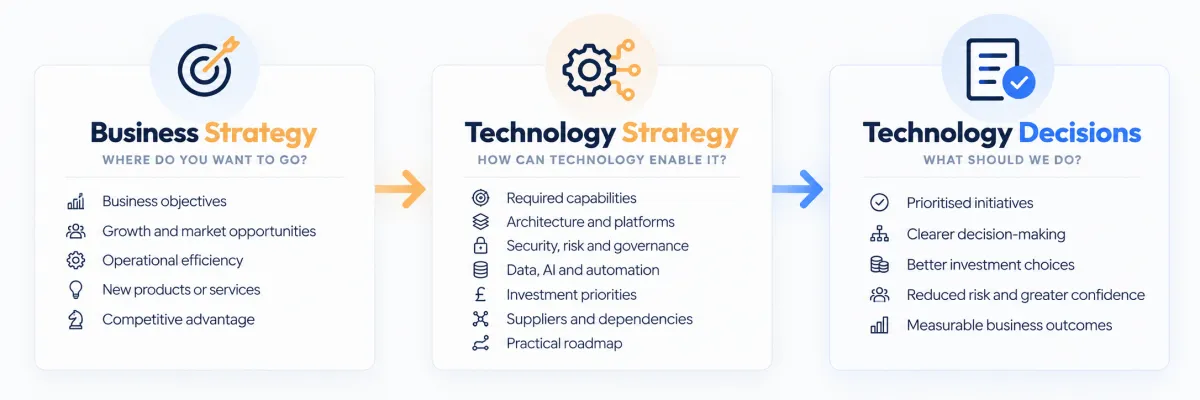
FROM TECHNOLOGY PROJECTS TO TECHNOLOGY STRATEGY
A Technology Strategy Is
More Than a List of Projects
Replacing a system isn't a strategy.
Moving something to the cloud isn't a strategy.
Deploying AI isn't a strategy.
Each might form part of one, but a technology strategy explains why technology needs to change, what capabilities the organisation requires and how individual decisions contribute to the wider objectives of the business.
THE OLD WAY: REACTIVE & DISCONNECTED
Without a clear Strategy
Technology decisions are often made in isolation, driven by immediate requirements, individual projects or supplier recommendations rather than a common business-led technology strategy.
THE SYSTEMASSURE WAY: STRATEGIC & UNIFIED
With a Technology Strategy
Technology decisions are coordinated around business objectives, creating clearer priorities, better investment decisions and a more sustainable technology roadmap.
Good technology strategy provides context for individual technology decisions.
When a new requirement, product, supplier or technology emerges, leadership has a framework against which to evaluate it.
From Current State to Future State
UNDERSTAND BEFORE YOU CHANGE
You Need to Know Where You're Starting
A strategy needs to be ambitious enough to support where the business is going, but grounded enough to recognise where it is today.
That means understanding the current technology environment — not simply producing an inventory of systems, but assessing how effectively they support the organisation.
We consider areas including:
Technology & Architecture
How systems, platforms, applications and integrations fit together. Are you creating value?.
Business Capabilities
Whether technology provides the capabilities the organisation needs today and in the future.
Data & Information
How information is created, shared, protected and used to support decisions.
AI &
Automation
Where new technologies improve productivity, create new capabilities or change processes.
Security
& Risk
Where technology introduces business risk and whether governance is appropriate.
Suppliers & Dependencies
Where the organisation relies on external providers, platforms or specialist expertise.
Technology Investment
Where money is being spent and whether that investment reflects business priorities.
People & Operating Model
Whether responsibilities, skills, processes and suppliers are aligned with the strategy.
Identify the Gap
CURRENT STATE → FUTURE STATE
What Needs to Change?
Once we understand where the organisation is today and where the business wants to go, we can identify the gap between the two.
Some existing technology may already support the future strategy.
Some may need to evolve.
Some may need to be replaced.
And sometimes the most important recommendation is not to introduce more technology at all.
SystemAssure helps identify which changes genuinely matter, the dependencies between them and where investment is likely to create the greatest business value.

Strategy Before Roadmap
STRATEGY & EXECUTION
A Strategy Tells You Where and Why
A Roadmap Tells You What and When
The terms technology strategy and technology roadmap are often used interchangeably, but they serve different purposes.
A technology strategy defines how technology will support the objectives of the organisation. It establishes principles, priorities, required capabilities and the direction of travel.
A technology roadmap turns that strategy into a sequence of initiatives, decisions and investments.
Without a strategy, a roadmap can become little more than a project schedule.
Without a roadmap, a strategy risks remaining an aspiration.
You need both.

What Does a Technology Strategy Cover?
CONNECTED DECISIONS
Technology Doesn't Operate in Isolation
A useful technology strategy brings together decisions that are too often considered separately.
Architecture and Platforms
Define the principles and target architecture that will guide future technology decisions, integration and scalability.
Cloud and
SaaS
Determine where cloud and SaaS services provide value and how platforms should be selected, governed and integrated.
AI and
Automation
Identify realistic opportunities for AI and automation and establish the governance required to adopt them responsibly.
Data and
Integration
Consider how information needs to flow between systems and how data can better support operations and decision-making.
Security, Resilience and Governance
Ensure risk, security and resilience are considered as part of technology decisions rather than added afterwards.
Investment and
Suppliers
Prioritise investment, understand dependencies and ensure supplier decisions support the strategy rather than define it.
Independent Technology Strategy
ADVICE WITHOUT A SALES AGENDA
The Strategy Should Determine the Technology
Not the Other Way Around
Technology strategies are sometimes shaped by the companies selling the technology.
* A cloud provider will naturally see opportunities for cloud.
* A software vendor sees opportunities for its software.
* An MSP may see opportunities for managed services.
Those perspectives can be valuable, but they aren't necessarily independent. SystemAssure approaches technology strategy from the perspective of the organisation.
We aren't starting with a particular product that needs to be sold.
We start with the business objective and work backwards to determine the capabilities, architecture and technology required to achieve it.
Strategy Informed by Implementation
FROM BOARDROOM TO BUILD
We Understand What Happens After the Strategy
A technology strategy has to survive contact with reality.
Architecture has constraints. Integrations are rarely as simple as diagrams suggest. Legacy systems exist for reasons. AI has limitations. Software development involves trade-offs. Suppliers have dependencies. Budgets aren't unlimited.
SystemAssure doesn't only advise organisations about technology.
We also design, build and operate technology products ourselves.
That practical experience influences the strategies we create. It helps us distinguish between ideas that look attractive in a presentation and approaches that can realistically be implemented.
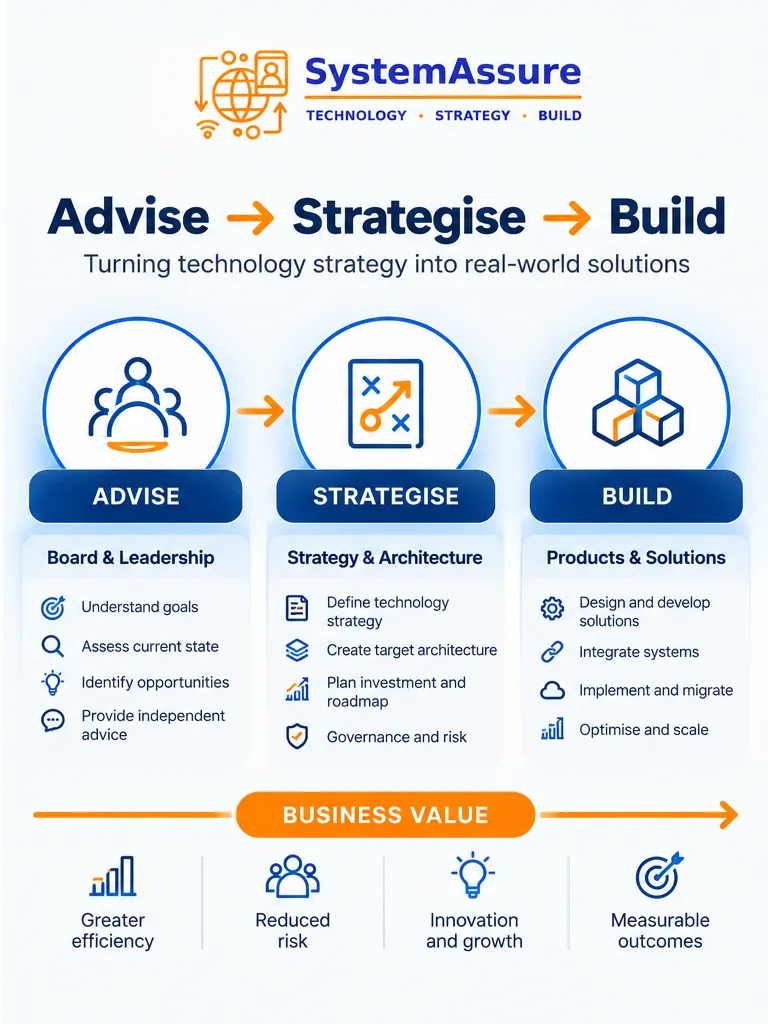
When Do You Need a Technology Strategy?
RECOGNISING THE TRIGGER
Sometimes the Existing Approach isn't Enough
An organisation doesn't need to wait for a technology crisis before developing a strategy.
Typical triggers include:
Business Growth
Existing systems, processes or technology structures are struggling to scale.
Business Transformation
The organisation is changing how it operates, serves customers or delivers products.
AI Adoption
Leadership needs to determine where AI genuinely fits rather than accumulating disconnected experiments.
Technology Complexity
Years of projects, suppliers and systems have created duplication or technical debt.
Acquisition or Integration
Different technology environments need to be assessed, consolidated or integrated.
New Leadership
A CEO, board, CIO or CTO wants an independent view of the current environment and future priorities.
Significant Investment
Major technology decisions are approaching and leadership wants confidence that investment is aligned with strategy.
New Products or Services
The organisation needs new technology capabilities to support a changing business model.
What Do You Get?
FROM STRATEGY TO ACTION
A Strategy You Can Actually Use
The exact outputs depend on the organisation and scope of the engagement, but a SystemAssure technology strategy would typically establish:
Business objectives and technology implications · Current-state assessment · Future capability requirements · Strategic technology principles · Target architecture · Key risks and dependencies · Investment priorities · Technology roadmap · Governance and ownership · Measures of success
The goal isn't to produce a large strategy document that gets filed away.
The goal is to create a decision-making framework and practical roadmap that leadership can use.
How We Engage
FLEXIBLE STRATEGIC SUPPORT
Technology Strategy Doesn't Have to Be a One-Off Exercise
For some organisations, technology strategy is a defined project.
For others, strategy needs to evolve as the business changes. SystemAssure can support both.
Technology Strategy Engagement
A defined engagement to assess the current environment, understand business objectives and develop the strategy and roadmap.
Strategy Review
An independent review of an existing technology strategy, roadmap or major investment programme.
Virtual CIO / CTO
Ongoing technology leadership to develop, maintain and execute the strategy alongside the executive team.
Board Technology Advisor
Independent support to help the board understand strategic technology decisions, opportunities and risks.
Frequently Asked Questions
What is a technology strategy?
A technology strategy defines how technology will support an organisation's business objectives. It establishes the capabilities, principles, architecture, priorities and investments required to move from the current environment towards the desired future state.
What is the difference between a technology strategy and an IT strategy?
The terms are sometimes used interchangeably, but technology strategy can be broader. An IT strategy often focuses on the systems and services required to operate the organisation, while technology strategy may also encompass digital products, AI, automation, data, software development and technology-enabled business opportunities.
What is the difference between a technology strategy and a technology roadmap?
The strategy establishes where the organisation is going and why. The roadmap defines what needs to happen and when to get there.
How often should a technology strategy be reviewed?
It should be reviewed whenever significant changes occur in the business, technology landscape or operating environment. Rather than treating strategy as a document recreated every few years, we favour a strategy that can be reviewed and adjusted as circumstances change.
Do we need a CIO or CTO to create a technology strategy?
Not necessarily. This is one reason organisations use SystemAssure. We can provide the senior CIO/CTO perspective required to develop the strategy while working alongside existing management, technology teams and suppliers.
Can you help implement the technology strategy?
Yes. Where appropriate, SystemAssure can remain involved through Virtual CIO/CTO leadership, architecture, SaaS development, AI and automation initiatives or oversight of third-party delivery.
START A CONVERSATION
Let's Start With the Business
You don't need to arrive with a technology strategy already defined.
Tell us where the organisation is going, what's changing, where technology is creating a challenge or where you believe there may be an opportunity.
We'll start there.
What is your Business trying to achieve?
Technology . Strategy . Build
Business aligned, strategy and SaaS development, from boardroom to build.
Services
Virtual CIO & CTO
Technology Strategy
Board Technology Advisor
SaaS Development


Insights
Technology Leadership
AI & Technology Strategy
SaaS & Product Development
Copyright © 2021 - 2026 SystemAssure ITSM Ltd. All rights reserved.