

Lovable Cloud vs Supabase: Which Architecture Is Right?
Lovable Cloud vs Your Own Supabase and APIs: Choosing the Right Architecture
Building an application quickly is one thing. Making the right architectural decisions for its future is another.
AI-assisted development platforms such as Lovable are changing how organisations build software. Applications that previously required weeks of development can now be prototyped, tested and, in some cases, deployed in days.
This creates opportunities for businesses to develop internal applications, automate processes, validate new products and bring Software-as-a-Service (SaaS) solutions to market more quickly.
However, as these applications evolve from prototypes into business-critical systems, an important question emerges:
Should you use Lovable Cloud to manage your application's backend infrastructure, or use Lovable for development while retaining control of your own Supabase environment and APIs?
Both approaches have advantages. Understanding the differences can help organisations avoid unnecessary complexity today without creating limitations tomorrow.
Understanding the Two Approaches
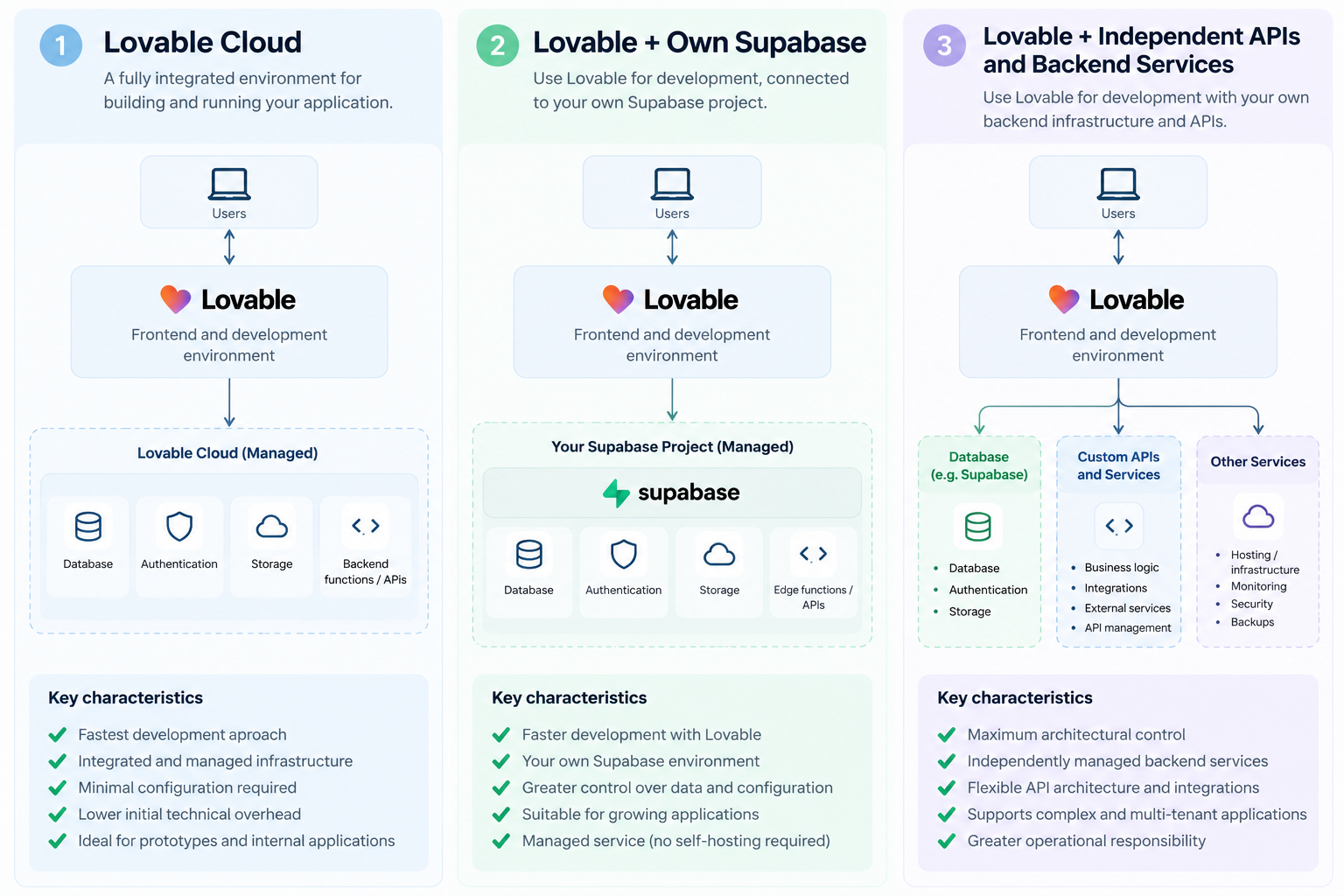
Option 1: Building with Lovable Cloud
Lovable Cloud provides an integrated environment for building and running applications.
Rather than configuring and maintaining separate backend services, developers can use Lovable's managed infrastructure for capabilities such as databases, authentication, storage and server-side functionality.
This reduces the number of services that need to be configured and managed independently.
For organisations developing a new application, the advantages are immediately apparent.
Faster development
Developers can concentrate on application functionality and user experience rather than spending time configuring infrastructure.
Reduced operational complexity
Backend services are managed through an integrated environment, reducing the number of separate systems requiring administration.
Simpler deployment
The relationship between application development and backend infrastructure is more tightly integrated, making it easier to move from development into testing and deployment.
Lower initial technical overhead
Organisations do not necessarily need extensive cloud infrastructure expertise to begin developing applications.
These characteristics make Lovable Cloud particularly attractive for prototypes, internal business applications, proof-of-concept projects and early-stage SaaS products.
However, simplicity also introduces architectural considerations.
When infrastructure is managed through a platform, organisations need to understand which elements they control directly, which are managed on their behalf and how easily those elements can be changed or migrated.
This is not necessarily a disadvantage. It is a trade-off that should be understood.
Option 2: Lovable with Your Own Supabase and APIs
An alternative is to use Lovable primarily as the application development environment while connecting it to independently managed backend services.
For example, an organisation might use:
Lovable to develop the application interface and associated code.
Its own Supabase project for database, authentication and storage services.
Independently deployed APIs for business logic and external integrations.
Cloud infrastructure under its own administrative control.
Separate monitoring, security and operational management services.
This approach introduces additional configuration and management responsibilities, but also provides greater architectural flexibility.
Greater infrastructure control
The organisation can manage its own backend environment, including database configuration, access controls, integrations and deployment policies.
Clearer separation of responsibilities
Application development can be separated from backend services, allowing different components to evolve independently.
More flexibility for integrations
Business logic and external integrations can be implemented through independently managed APIs rather than being tightly coupled to a particular application development platform.
More control over the technology lifecycle
The organisation can make independent decisions about backend infrastructure, deployment environments and service providers.
Potentially greater portability
An independently managed backend may make it easier to change application development tools or introduce additional applications that use the same services.
However, portability is not automatic. It depends on how the application is designed, how business logic is implemented and which platform-specific services are used.
The trade-off is that the organisation becomes responsible for more of the architecture and its ongoing operation.
Comparing the Two Approaches
Neither approach is inherently better. Each optimises for different priorities.
Consideration | Lovable Cloud | Own Supabase and APIs |
|---|---|---|
Initial development speed | Typically faster | Additional setup required |
Infrastructure configuration | Largely managed | Greater direct control |
Initial technical complexity | Lower | Higher |
Database administration | Integrated management | Independently managed |
Authentication | Integrated services | Configurable within own environment |
API architecture | Integrated backend capabilities | Independently designed and deployed |
Operational responsibility | More platform-managed | More organisation-managed |
Infrastructure flexibility | Subject to platform capabilities | Greater flexibility |
Application portability | Depends on architecture and migration options | Potentially greater |
Scaling | Managed within platform capabilities | Independently configurable |
Security responsibility | Shared with platform provider | Greater direct responsibility |
Cost management | Integrated usage and platform costs | Separate infrastructure and operational costs |
Long-term flexibility | Depends on evolving requirements | Potentially greater architectural independence |
The most important distinction is not simply where the database resides.
It is how much control the organisation needs over the application's architecture, operation and future development.
The Cost Question: Is Managed Infrastructure Really Cheaper?
It is tempting to compare the subscription and usage costs of Lovable Cloud against the direct cost of running Supabase and other cloud services.
However, this rarely provides a complete picture.
There are several components to consider.
Initial development costs
Lovable Cloud can reduce the time needed to configure and integrate backend services.
For a small project, this saving can be significant.
An independently managed environment may require additional development effort to configure authentication, databases, APIs, secrets management, deployment pipelines and monitoring.
Ongoing infrastructure costs
Managed platforms typically charge according to their pricing model and resource consumption.
Independent infrastructure introduces separate charges for services such as database hosting, compute, storage, networking, monitoring and backups.
Depending on application usage, either approach may be more economical.
Operational costs
Infrastructure requires management.
Security updates, monitoring, backup verification, incident response, performance optimisation and service availability all have associated costs.
With managed services, some of these responsibilities are handled by the provider.
With independently managed services, the organisation assumes more direct responsibility.
The cost of future change
Perhaps the least visible consideration is the cost of changing the architecture later.
An application that begins as a simple internal tool may eventually need to support multiple customers, complex integrations, additional compliance requirements or different deployment environments.
If those requirements are foreseeable, making appropriate architectural decisions early may reduce future redevelopment costs.
The lowest initial development cost does not necessarily produce the lowest total cost of ownership.
Equally, investing in complex infrastructure before it is needed can waste money and delay delivery.
The objective should be to introduce the right level of complexity at the right time.
Security, Data Ownership and Compliance
For organisations handling sensitive or commercially important information, infrastructure decisions extend beyond development convenience.
Questions worth considering include:
Where is the data stored?
Organisations may have requirements relating to data residency, geographic location or contractual restrictions.
Who controls access?
Understanding administrative access, authentication, service permissions and privileged operations is essential.
How are backups and recovery managed?
A database backup is not necessarily equivalent to a complete application recovery capability.
What happens if the platform becomes unavailable?
Organisations should understand their dependencies, recovery options and the implications of a prolonged service disruption.
Can the application and its data be migrated?
Data export, database compatibility and application code portability should be considered before the application becomes business-critical.
Using Lovable Cloud does not automatically make an application insecure, just as operating your own Supabase environment does not automatically make it secure.
Security depends on the controls implemented, the responsibilities understood and the operational practices maintained.
For regulated organisations, the ability to demonstrate those controls may be as important as the controls themselves.
The Importance of API Architecture
One of the most significant architectural decisions is where business logic should reside.
Consider an application that integrates with several external services.
A simple implementation might connect application functionality directly to those services through backend functions.
This may be entirely appropriate for an early-stage application.
However, as requirements become more complex, organisations may benefit from separating business logic into independently managed APIs.
For example, an API layer could manage:
Authentication and authorisation between services.
Integration with third-party systems.
Data validation and business rules.
Rate limiting and request management.
Audit logging and operational monitoring.
Reusable functionality shared by multiple applications.
This separation becomes particularly valuable when several applications need access to the same information or services.
It can also simplify future development.
An organisation might initially build a web application using Lovable, then introduce a mobile application, customer portal or integration with an existing enterprise system.
If the underlying business capabilities are exposed through appropriately designed APIs, those additional applications can reuse them.
The important point is that an independent API architecture is a design choice, not simply a hosting choice.
It is possible to create poorly structured APIs using independently managed infrastructure, just as it is possible to design well-structured application services within a managed environment.
What About Multi-Tenant SaaS Applications?
The architectural considerations become more significant when developing software intended to serve multiple customers.
A single-customer application has different requirements from a SaaS platform supporting hundreds of organisations.
Multi-tenant applications may need to address:
Tenant isolation
Ensuring that one customer's data and operations cannot be accessed by another customer.
Customer-specific configuration
Different customers may require separate integrations, authentication settings, branding or application behaviour.
Scalability
Infrastructure must accommodate growth in users, customers, data volumes and processing requirements.
Usage monitoring and billing
The application may need to measure resource consumption, manage subscriptions and support different commercial models.
Administrative boundaries
Platform administrators, partners, service providers and individual customers may require different levels of access.
Operational visibility
The software provider needs to understand application performance, service availability and issues affecting individual customers.
These requirements do not automatically exclude Lovable Cloud.
However, they make architectural planning increasingly important.
For a multi-tenant SaaS product, it may be appropriate to separate the application interface from tenant management, business logic, integration services and data access.
An independently managed backend can provide additional control over these components.
Nevertheless, the critical factor remains the application architecture rather than the choice of hosting provider alone.
Platform Dependency and Vendor Lock-In
Vendor lock-in is often discussed as though it is inherently undesirable.
In practice, almost every technology decision creates some level of dependency.
Organisations using Microsoft Azure, AWS, Salesforce or other managed platforms accept dependencies in exchange for functionality, operational simplicity and faster delivery.
The same principle applies to Lovable Cloud.
The relevant question is not whether a dependency exists, but whether its implications are understood and acceptable.
For example:
Can application source code be exported and maintained independently?
Can database structures and information be migrated?
Are authentication and identity services portable?
Is important business logic dependent on proprietary platform functionality?
What would be involved in moving the application to another environment?
Could the organisation continue operating the application without using Lovable?
The answers should be assessed against the application's commercial importance.
For an internal departmental application, the cost of changing platforms may be relatively modest.
For a business whose principal product is a SaaS application, architectural independence may carry considerably greater strategic value.
Importantly, choosing your own Supabase environment does not eliminate dependency. It changes the nature of that dependency and potentially gives the organisation more options for managing it.
A Third Option: The Hybrid Approach
The decision does not always need to be between a completely managed application and a fully independent infrastructure.
A hybrid architecture can provide a useful middle ground.
For example, an organisation might:
Use Lovable to accelerate frontend application development.
Retain selected managed services where they reduce operational complexity.
Use independently managed APIs for critical business logic and integrations.
Keep important data services under its own administrative control where required.
Introduce additional infrastructure only when business requirements justify it.
This approach allows organisations to retain the development benefits of Lovable without necessarily coupling every aspect of the application to a single environment.
It also creates opportunities for gradual architectural evolution.
Rather than undertaking a complete migration when requirements change, individual components may be separated or replaced as the application matures.
However, hybrid architectures also introduce additional integration and operational complexity.
They should be adopted because they solve a genuine requirement, not simply because they appear more sophisticated.
Which Approach Should You Choose?
There is no universal answer, but several practical guidelines can help.
Choose Lovable Cloud when speed and simplicity are the priorities
Lovable Cloud is likely to be an attractive option when:
Developing a proof of concept or minimum viable product.
Building an internal business application.
Validating whether a product has commercial potential.
Working with limited infrastructure expertise.
Minimising initial development and operational overhead.
Application requirements are relatively straightforward.
In these circumstances, introducing a complex independent backend may provide little immediate benefit.
Consider your own Supabase and API infrastructure when control and flexibility matter more
An independently managed architecture may be preferable when:
Developing a commercially important SaaS product.
Supporting complex multi-tenant requirements.
Integrating with numerous external systems.
Requiring greater control over data management and security.
Supporting multiple applications using shared backend services.
Planning for significant growth or architectural change.
Needing specific infrastructure, compliance or operational controls.
The additional investment may be justified by the greater control it provides.
Consider a hybrid approach when requirements are evolving
A hybrid approach may be appropriate when the organisation wants to maintain development speed while gradually introducing more structured backend services.
This can be particularly useful for applications moving from prototype to production, where future requirements are becoming clearer but do not yet justify a complete architectural redesign.
Architecture Should Follow Business Requirements
One of the risks associated with increasingly accessible development tools is that organisations can begin building software before they have fully considered its purpose, operating model and future requirements.
This is understandable.
When an application can be developed quickly, there is a natural temptation to start building immediately.
However, the ease of creating software does not remove the need for architectural thinking.
Before committing to a particular approach, organisations should consider:
What business problem is the application solving?
Who will use it, and how might that change?
How important will the application become to business operations?
What information will it process and store?
What integrations will it require?
What are the likely security and compliance obligations?
How might the application evolve over the next two or three years?
What would be the consequences of needing to change the underlying architecture?
Not every question needs a definitive answer at the beginning.
But understanding the potential implications allows decisions to be made deliberately rather than by default.
The SystemAssure Perspective
At SystemAssure, we see AI-assisted development as an important opportunity for organisations to solve business problems more quickly and economically.
Tools such as Lovable are making software development accessible to organisations that might previously have considered bespoke applications too expensive or complex.
However, development speed is only one element of a successful technology investment.
The underlying architecture needs to support the business objectives, operational requirements and commercial expectations of the organisation.
For some applications, Lovable Cloud will provide everything required.
For others, independently managed Supabase services and APIs may offer important advantages.
And in many cases, a carefully considered hybrid architecture will provide an appropriate balance.
The objective is not to build the most technically sophisticated solution. It is to build the solution that best supports the business, both today and as its requirements evolve.
Discuss Your Technology Challenge
Whether you are considering a new application, developing a SaaS product or reviewing the architecture of an existing solution, SystemAssure provides independent advice to help you understand the options and make informed decisions.
We help organisations evaluate technology choices in the context of their business objectives, investment priorities and long-term requirements.