

Why I Built SaaS Sentinel: The Founder's Story
From managing a handful of SaaS applications to building a platform that helps developers keep their applications live, secure, scalable and profitable.
Building a SaaS application has become remarkably easy.
With development platforms such as Lovable, it's now possible to take an idea, build a working application, connect a database, implement authentication and deploy it to production in a fraction of the time it would have taken just a few years ago.
But there's a significant difference between building a SaaS application and operating a SaaS business.
That's the problem that led me to create SaaS Sentinel.
It Started With My Own Applications
Over the years, I've worked extensively in enterprise systems management, IT operations, technology strategy and SaaS product development.
One lesson from that experience has remained consistent: you cannot effectively manage what you don't regularly measure and monitor.
More recently, through SystemAssure, I began developing and operating a growing portfolio of SaaS applications.
Initially, managing them was straightforward.
Each application had its own hosting environment, database, authentication, integrations and supporting services. The development and hosting platforms provided dashboards showing operational information.
With one application, that was manageable.
I knew where everything was, which dashboards to check and what needed attention.
But as the number of applications increased, things became more complicated.
One application might have a database approaching its resource limits. Another might have an outdated dependency or a configuration issue. A third might be consuming more infrastructure resources than expected.
None of these problems necessarily causes an immediate outage.
Instead, they can develop gradually, unnoticed, until they become more serious.
The information was available, but it was scattered across multiple dashboards, accounts and platforms.
I didn't need another individual monitoring dashboard. I needed a way to manage the entire portfolio.
The Problem Was Bigger Than Monitoring
My initial thinking was focused on operational monitoring.
I wanted to know whether my applications were available, whether their supporting infrastructure was healthy and whether anything required attention.
But it quickly became apparent that availability was only part of the problem.
There were several questions I wanted to answer consistently across every application:
Availability: Is the application running, and are its critical services accessible?
Security: Are there vulnerabilities, configuration weaknesses or dependencies that need updating?
Capacity: Is the infrastructure sufficient for current and future demand?
Costs: How much does each application actually cost to operate?
Profitability: What does it cost to deliver each customer licence, and is the pricing sustainable?
Some answers could be found in Lovable or Supabase. Others required checking external services, reviewing invoices or maintaining spreadsheets. Some required calculations that the individual platforms weren't designed to provide.
This was particularly true of SaaS costs.
Understanding the Real Cost of a SaaS Licence
During my time at Almaden, I was involved in SaaS pricing and cost management, so I understood the importance of knowing what it actually costs to deliver a service.
It's surprisingly easy to underestimate those costs.
Developers often consider their hosting and database subscriptions, but what about AI API usage, email delivery, monitoring, authentication, storage, payment processing and shared infrastructure?
And what happens when several applications use the same services?
A £20 monthly subscription might look profitable until you calculate the actual cost of delivering it.
I wanted SaaS Sentinel to help answer a simple question:
How much does each licence cost me to deliver, and how does that change as the application grows?
That meant looking beyond infrastructure monitoring and introducing cost allocation, licence economics and capacity planning.
It also meant thinking about SaaS applications as businesses rather than simply software projects.
Building SaaS Sentinel
Having identified the problem, I decided to build the solution I needed.
The approach was straightforward: start with my own requirements, build something useful and extend it as additional needs became apparent.
Lovable made it possible to develop and iterate rapidly, concentrating on the application functionality and user experience rather than spending months building the initial foundations.
But the objective wasn't simply to build another dashboard.
I wanted a platform that could bring together information from different services and turn it into something actionable.
The design needed to support multiple SaaS applications, each potentially using different infrastructure, services and development approaches.
It also needed to accommodate both Lovable Cloud applications and Lovable projects using their own Supabase environments.
Bringing the information together
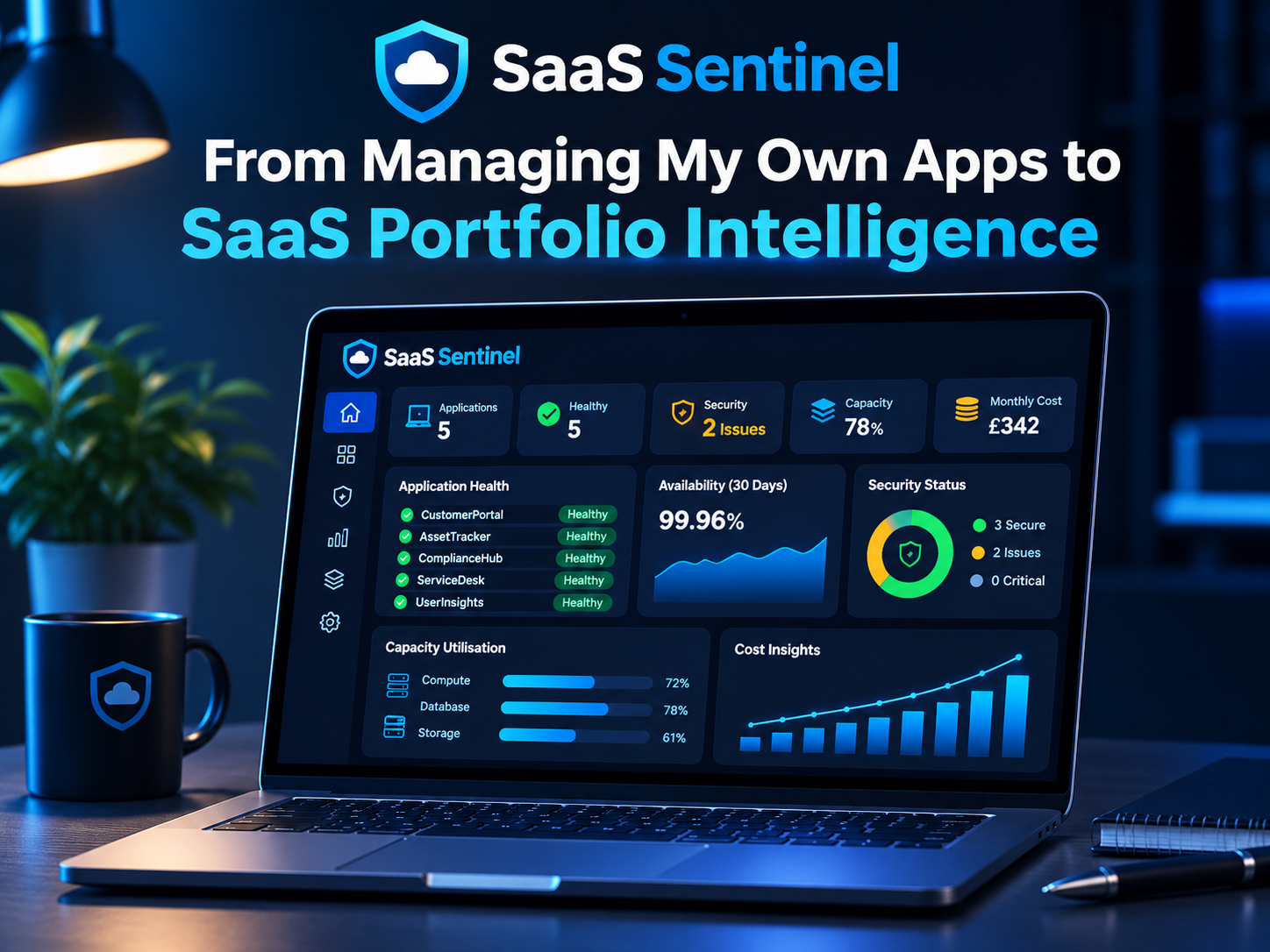
The central idea was to create a single place to see the operational condition of every application.
Rather than opening several dashboards, I wanted to be able to identify which applications needed attention and then investigate the underlying issue.
This led to a focus on availability monitoring, infrastructure utilisation, security checks, dependency monitoring and notifications.
The aim wasn't to replace every specialist tool.
It was to make the information from those tools more useful when managing multiple applications.
Making security part of everyday operations
Security was another important consideration.
An application can be running perfectly well while still having security weaknesses.
Outdated dependencies, expiring certificates, DNS configuration problems and other issues can remain unnoticed if nobody checks them regularly.
I wanted SaaS Sentinel to make these checks part of routine SaaS operations rather than something developers only investigate after a problem occurs.
Scheduled checks and alerts help reduce the need to remember every individual task.
Adding the commercial perspective
The next important consideration was cost.
Traditional application monitoring generally focuses on performance, availability and errors.
Those are essential, but they don't tell you whether the application is financially sustainable.
By bringing together operational and commercial information, SaaS Sentinel could provide a more complete view of each application.
This became one of the most important aspects of the product.
From Monitoring to SaaS Portfolio Intelligence
As the product developed, I realised that describing SaaS Sentinel simply as a monitoring platform didn't adequately explain what I was trying to achieve.
Monitoring tells you whether something is working.
But managing a SaaS portfolio requires understanding much more.
You need to know whether applications are secure, whether infrastructure will support growth, whether costs are increasing and whether your pricing model remains viable.
That thinking led to the term SaaS Portfolio Intelligence (SPI).
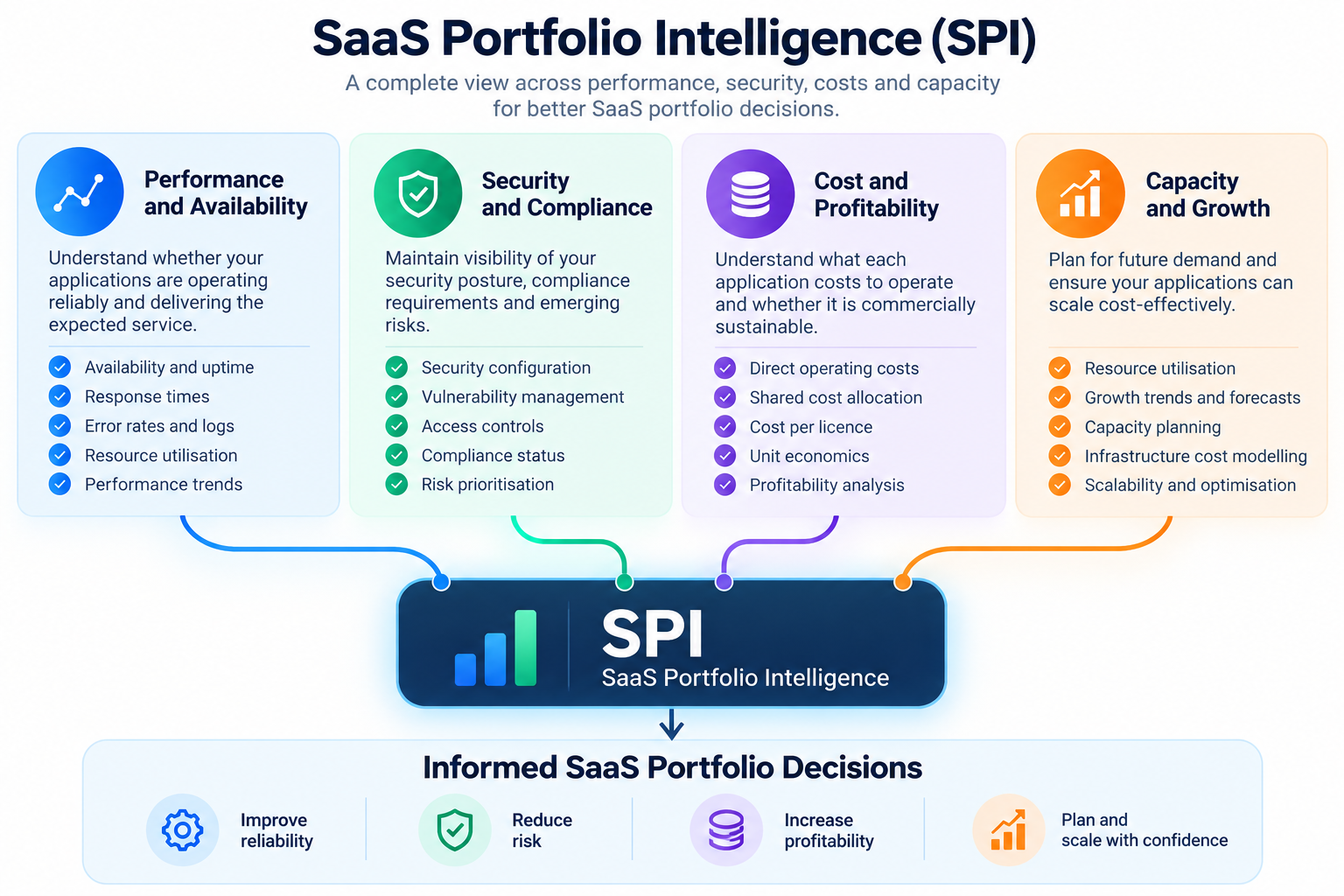
For me, SPI describes the combination of operational, security, capacity and financial information needed to make informed decisions about a portfolio of SaaS products.
It's about moving from collecting information to understanding what that information means.
And, importantly, identifying what needs attention before a small problem becomes a significant one.
Why I Think Lovable Developers Need This
Lovable has made SaaS development accessible to a much wider audience.
That's a very positive development.
Entrepreneurs, small businesses and independent developers can now create applications without the time and investment traditionally associated with software development.
However, the responsibility for operating those applications doesn't disappear.
Once customers start using an application, expectations change.
They expect it to be available, secure, responsive and reliable.
As the number of customers grows, so does the importance of capacity planning, cost control, backups and recovery procedures.
The tools provided by Lovable, Supabase and other infrastructure providers are valuable, but they naturally focus on their own platforms.
SaaS Sentinel is intended to provide the broader perspective.
And although Lovable developers are an important audience, the underlying challenges apply to anyone operating multiple SaaS applications.
Built From Experience, Not Just an Idea
One of the advantages of building SaaS Sentinel for my own use is that the requirements are grounded in practical experience.
I've spent many years working with enterprise systems management, service availability, operational monitoring and technology governance.
I've also experienced the commercial side of SaaS, including pricing, licensing and infrastructure costs.
SaaS Sentinel brings those two perspectives together.
The operational side asks whether the service is healthy, secure and capable of supporting demand.
The commercial side asks whether the service is sustainable and profitable.
Both matter.
A technically excellent SaaS application that loses money on every customer isn't a sustainable business.
Equally, a profitable application that regularly fails or exposes customers to unnecessary security risks won't remain successful for long.
What Comes Next?
SaaS Sentinel began as a solution to a problem I was experiencing myself.
But it's a problem I believe many other developers and SaaS operators will recognise.
As building software becomes faster and easier, managing what we've built becomes increasingly important.
My intention is to continue developing SaaS Sentinel around the practical requirements of operating SaaS applications, improving visibility, reducing repetitive checks and helping developers make better operational and commercial decisions.
I also want the platform to remain useful for developers managing just a few applications, not only organisations operating large SaaS portfolios.
Because that's where the problem often begins.
You build one application. Then another. Then a third.
Before long, you're spending more time checking dashboards, reviewing costs and remembering maintenance tasks than you expected.
That's exactly why I created SaaS Sentinel.
Building Is Only the Beginning
The ability to build SaaS applications quickly is changing the software industry.
But launching an application is not the end of the journey.
It's the beginning of operating a service that customers depend on.
SaaS Sentinel exists to help developers and SaaS businesses keep their applications live, secure, scalable and profitable.
It started with my own portfolio. My hope is that it will make managing yours easier too.
Peter Stevens
Author, SaaS Sentinel
Explore SaaS Sentinel:saassentinel.co.uk