

Virtual CIO vs Virtual CTO: Differences & When You Need Both
Virtual CIO vs Virtual CTO: What Is the Difference, and When Does a Business Need Both?
Technology leadership is no longer something only large organisations need. But when a business decides it needs senior technology expertise, should it appoint a Virtual CIO, a Virtual CTO, or both?
For many businesses, technology has evolved from a supporting function into something fundamental to their operations, competitiveness and future growth.
That creates an interesting challenge.
An organisation may need someone to ensure its existing technology is secure, reliable and cost-effective. At the same time, it may need someone to help develop new digital products, evaluate emerging technologies or create new business opportunities.
These are related responsibilities, but they are not necessarily the same job.
Traditionally, organisations have addressed these requirements through two executive roles: the Chief Information Officer (CIO) and the Chief Technology Officer (CTO).
Today, businesses can access the same strategic expertise through Virtual CIO (vCIO) and Virtual CTO (vCTO) services, without necessarily employing either executive full-time.
But what is the difference, and when does having both make sense?
What Does a Virtual CIO Do?
A Virtual Chief Information Officer (vCIO) provides strategic leadership over how technology supports the organisation's operations, people and business objectives.
The emphasis is typically on ensuring that technology investments deliver measurable business value while managing operational risk.
A vCIO looks at the organisation as a whole.
Rather than concentrating exclusively on individual systems or technical projects, they consider how technology supports the business strategy, whether existing investments are delivering value and where improvements are required.
Typical responsibilities include:
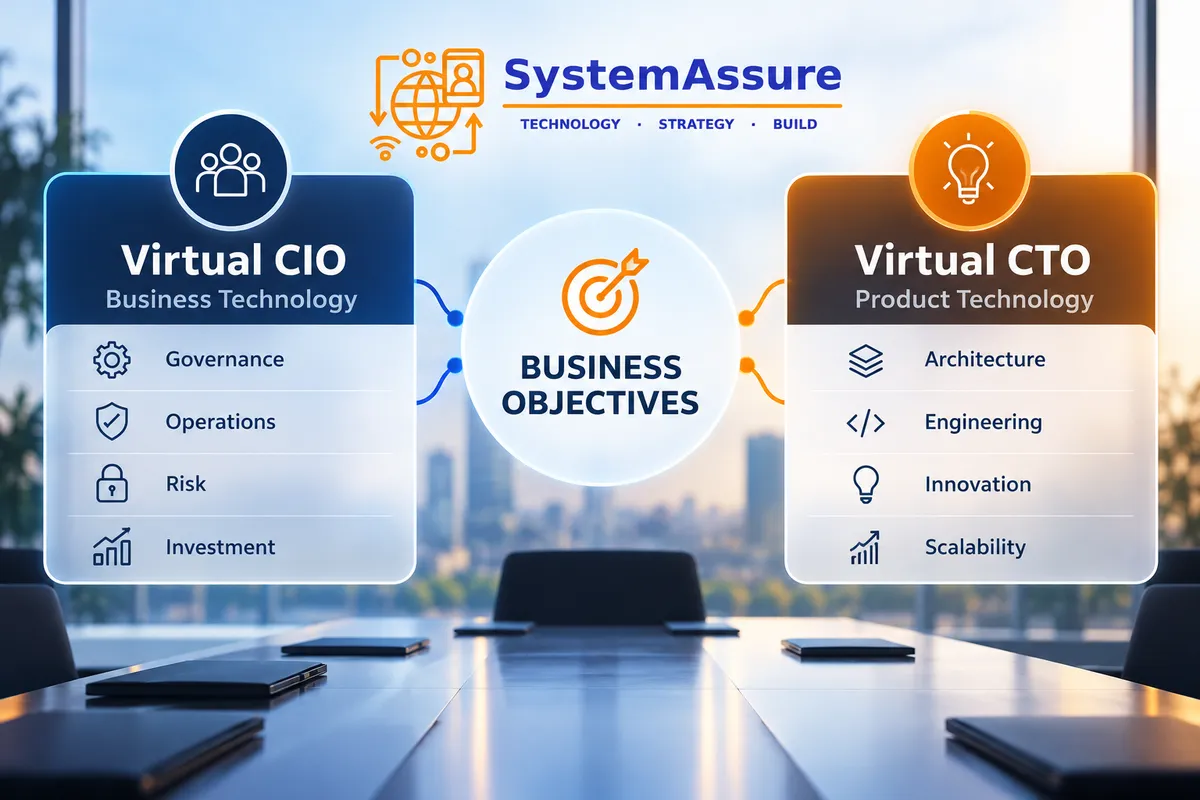
Technology strategy: Developing a technology roadmap aligned with business objectives.
IT governance: Establishing accountability, policies and decision-making processes.
Cybersecurity and risk: Ensuring technology risks are understood, appropriately managed and communicated to leadership.
Technology investment: Evaluating expenditure, supplier relationships and the return on technology investments.
Operational effectiveness: Improving the reliability, efficiency and effectiveness of existing technology services.
Business continuity: Ensuring the organisation can continue operating when technology services fail.
Digital transformation: Helping the business adopt new technologies and improve existing processes.
Board reporting: Translating technical issues into business implications that directors can understand and act upon.
A good vCIO is not simply a senior IT manager working remotely.
Their value comes from understanding the business, challenging assumptions and helping leadership make better decisions about technology.
The Virtual CIO's Central Question
"How can technology best support our business objectives while controlling cost, complexity and risk?"
This question applies whether the organisation employs five people or five thousand.
The scale of the technology environment changes, but the underlying leadership requirement remains.
What Does a Virtual CTO Do?
A Virtual Chief Technology Officer (vCTO) typically focuses on the technology that enables an organisation to develop products, services, platforms and new capabilities.
Where the CIO is often concerned with how technology supports the business, the CTO is frequently concerned with how technology creates competitive advantage.
This distinction is particularly relevant to software businesses, SaaS providers, technology-enabled service companies and organisations developing proprietary digital platforms.
Typical responsibilities include:
Technology architecture: Defining the technical foundations of products, applications and platforms.
Product technology strategy: Ensuring technology choices support product development and commercial objectives.
Software engineering leadership: Establishing development standards, processes and technical direction.
Technology selection: Evaluating frameworks, platforms, infrastructure and development approaches.
Scalability: Ensuring systems can support growth in customers, users and transaction volumes.
Technical debt: Balancing short-term delivery against long-term maintainability.
Innovation: Evaluating emerging technologies and their potential commercial applications.
Technical due diligence: Assessing the quality, sustainability and risks associated with technology assets.
A vCTO may work closely with development teams, product managers, external software suppliers and commercial leadership.
However, the role is not simply that of a senior software developer or architect.
The vCTO must understand the commercial implications of technical decisions.
Choosing the wrong architecture, platform or development approach can have consequences that extend far beyond the engineering team.
The Virtual CTO's Central Question
"What technology should we build or adopt to deliver our products, services and future competitive advantage?"
For organisations developing technology-based products, this can be one of the most important strategic questions they face.
Virtual CIO vs Virtual CTO: The Key Differences
Although responsibilities frequently overlap, the following comparison illustrates the traditional distinction.
Area | Virtual CIO | Virtual CTO |
|---|---|---|
Primary focus | Technology supporting business operations | Technology enabling products, services and innovation |
Strategic objective | Business effectiveness, governance and risk management | Product capability, differentiation and scalability |
Technology ownership | Internal systems and enterprise technology | Product platforms, applications and technical architecture |
Financial focus | IT budgets, investment value and operational costs | Development investment, technical sustainability and product economics |
Risk management | Cybersecurity, compliance, continuity and operational risk | Architecture, scalability, security and technical delivery risk |
Key stakeholders | CEO, CFO, COO, business leaders and board | CEO, product leadership, engineering teams and commercial leadership |
Typical deliverables | IT strategy, governance framework, investment roadmap | Technology architecture, engineering strategy, product technology roadmap |
Success measures | Business outcomes, operational resilience and investment effectiveness | Product delivery, scalability, technical quality and competitive advantage |
These distinctions are useful, but they are not universal.
In some organisations, the CTO is responsible for all technology, including internal IT.
In others, the CIO leads significant software development and innovation programmes.
The important distinction is not the job title. It is the business responsibility and the outcomes the organisation needs.
When Does a Business Need a Virtual CIO?
A business may benefit from a vCIO when technology decisions have become too important, expensive or complex to be managed as an additional responsibility by the CEO, finance director or an operational manager.
This often happens gradually.
The organisation acquires more systems, becomes increasingly dependent on cloud services, faces greater cybersecurity expectations and begins to struggle with technology suppliers that each provide only part of the picture.
Eventually, someone needs to take responsibility for the overall direction.
Consider a professional services business with 80 employees.
It uses Microsoft 365, several cloud-based business applications, a CRM platform, financial systems and outsourced IT support.
Its technology generally works.
However, the leadership team is concerned about rising costs, cybersecurity exposure, inconsistent processes and whether its current systems will support future growth.
The organisation probably does not need a full-time CIO.
But it could benefit significantly from independent strategic technology leadership.
A vCIO could review the existing environment, establish priorities, challenge suppliers, develop an investment roadmap and provide the board with a clearer understanding of technology risks and opportunities.
The objective is not to create another management layer.
It is to ensure technology decisions are made deliberately rather than reactively.
When Does a Business Need a Virtual CTO?
A vCTO becomes particularly valuable when an organisation is developing technology that is central to its products, services or competitive position.
Consider a company developing a SaaS application.
It has an innovative idea, an initial product and a small development team.
Perhaps the application was originally built using a low-code development platform or an outsourced software development partner.
The product is gaining customers, but questions are emerging.
Will the current architecture support thousands of users?
Is the application sufficiently secure?
How should the business manage customer data?
Does the platform support multiple customers or organisations without compromising isolation?
What happens if the original development partner becomes unavailable?
How much technical debt is accumulating?
Should the company continue with its existing platform or invest in a different architecture?
These are not simply development questions. They are commercial decisions with potentially significant long-term consequences.
A vCTO can help the organisation evaluate these choices, establish an appropriate technical strategy and ensure the product can evolve as the business grows.
The organisation may already have excellent developers.
What it needs is someone who can connect their technical decisions to the wider commercial strategy.
When Does a Business Need Both a Virtual CIO and a Virtual CTO?
The need for both roles usually emerges when an organisation has two distinct technology responsibilities.
First, it must operate its own business effectively.
Second, it must develop or deliver technology as part of its commercial offering.
A growing SaaS company is a useful example.
Internally, it needs reliable business systems, cybersecurity governance, identity management, financial controls, employee technology and business continuity.
Externally, it needs a secure, scalable software platform, a development strategy, technical architecture and an effective engineering organisation.
These two environments share common concerns, particularly security, compliance and cost.
But their priorities can be very different.
The CIO may be concerned about reducing operational complexity and improving governance.
The CTO may be focused on accelerating product development and introducing capabilities that differentiate the business.
Both perspectives are legitimate, and sometimes they create tension.
Example: A Technology Investment Decision
Imagine a growing SaaS business considering the adoption of a new AI platform.
The CTO sees an opportunity to introduce capabilities that could significantly improve the product and differentiate it from competitors.
The CIO raises questions about data protection, information governance, supplier risk, contractual obligations and the organisation's ability to support the technology.
Neither perspective is inherently more important.
The business needs to understand both.
A sound decision considers the commercial opportunity alongside the operational, financial and regulatory implications.
This is where having both perspectives can be particularly valuable.
The CTO helps determine what is technically possible and commercially valuable. The CIO helps ensure the organisation can adopt and operate it responsibly.
Together, they help leadership make a more informed investment decision.
Does Having Both Mean Paying for Two Executives?
Not necessarily.
One of the principal advantages of virtual technology leadership is flexibility.
An organisation may need ongoing CIO-level oversight but only occasional CTO expertise.
Alternatively, a software company may require regular CTO involvement while needing CIO support primarily for governance, cybersecurity and internal technology strategy.
There is no reason both roles must involve equivalent commitments.
For example, a business might engage a vCIO for a regular monthly governance and strategy commitment, while using a vCTO for specific architecture reviews, product planning or major technical decisions.
Another organisation might reverse those arrangements.
Smaller businesses may find that one experienced technology adviser can cover both responsibilities, particularly during their early stages.
The important consideration is whether the individual genuinely possesses the necessary breadth of experience.
A strong background in corporate IT does not automatically translate into expertise in SaaS architecture and software engineering.
Equally, an excellent software engineering leader may have limited experience in enterprise governance, business continuity or IT financial management.
The roles overlap, but they require different combinations of skills.
Can One Person Act as Both Virtual CIO and Virtual CTO?
Yes, and for some organisations this may be the most practical approach.
However, the decision should be based on the organisation's requirements rather than simply finding someone willing to adopt both titles.
In a smaller business, the technology environment may be sufficiently straightforward for one individual to provide strategic oversight across internal IT and product development.
As the organisation grows, the complexity and demands of each responsibility may increase.
At that point, separating the roles can provide greater focus and more effective governance.
There is also an important question of independence.
If the same person is responsible for proposing a technology investment, approving its architecture, assessing its risks and evaluating its success, the organisation may lose some valuable independent challenge.
This does not mean the roles must always be separated.
It means the governance arrangements should reflect the significance of the decisions being made.
An independent technology adviser can sometimes provide that additional perspective without requiring another executive appointment.
What About a Fractional CIO or Fractional CTO?
The terms virtual and fractional are frequently used interchangeably.
In practice, both describe ways of accessing senior technology leadership without employing a full-time executive.
A fractional executive generally works with an organisation for an agreed proportion of their time, often becoming closely involved in leadership meetings, decision-making and ongoing management.
A virtual executive may operate in much the same way, although the term is sometimes used for a more advisory or service-based relationship.
Neither title guarantees a particular level of involvement.
What matters is the scope of responsibility, authority, availability and accountability.
Businesses should establish these expectations before engaging either type of service.
For a more detailed discussion, see our article on Fractional CTO vs Virtual CTO: Are They the Same Thing?
The Role of Independent Technology Advice
There is another option that organisations sometimes overlook.
Not every business needs someone to take operational responsibility for its technology.
Sometimes the leadership team already has capable internal managers, trusted suppliers or an established development team.
What it lacks is an independent perspective.
Someone who can challenge proposals, assess competing options, identify risks and explain the business implications of technical decisions.
This is particularly valuable when considering:
Significant technology investments or transformation programmes.
Developing or acquiring software products.
Replacing critical business systems.
Outsourcing technology services.
Evaluating AI opportunities.
Assessing cybersecurity and operational resilience.
Preparing for investment, acquisition or due diligence.
An independent adviser does not necessarily replace a CIO or CTO.
Instead, they help the board and leadership team understand whether the organisation has the right technology leadership, capabilities and governance for its circumstances.
In some cases, the recommendation may be to appoint a vCIO.
In others, a vCTO may be more appropriate.
And sometimes the existing arrangements are perfectly adequate, with only targeted specialist support required.
The objective should be to solve the business problem, not to introduce a job title.
How Should a Business Decide What It Needs?
Before engaging a Virtual CIO or Virtual CTO, business leaders should consider three questions.
1. What Business Problem Are We Trying to Solve?
If the primary challenges concern internal systems, technology costs, cybersecurity, governance or operational efficiency, a vCIO may be the more appropriate starting point.
If the challenges concern software products, technical architecture, development teams or platform scalability, a vCTO may be more relevant.
If both sets of challenges are significant, the business may need both perspectives.
2. Do We Need Leadership, Delivery or Independent Advice?
These are different requirements.
An organisation may need someone to assume responsibility for technology strategy and lead its implementation.
Alternatively, it may need specialist expertise to deliver a defined project.
Or it may simply need an experienced independent adviser to evaluate proposals and help leadership make informed decisions.
Understanding this distinction can prevent businesses from paying for an ongoing executive service when a focused advisory engagement would be more appropriate.
3. How Much Involvement Is Actually Required?
Not every organisation needs weekly executive meetings or continuous technology oversight.
Some benefit from regular strategic reviews, supported by additional involvement during major decisions or projects.
Others require an embedded technology leader who works closely with the management team.
The right arrangement should reflect the complexity, maturity and risk profile of the business.
Conclusion: Start With the Business Need, Not the Job Title
The difference between a Virtual CIO and a Virtual CTO is best understood through the business outcomes each role is expected to deliver.
A Virtual CIO typically focuses on ensuring technology supports the organisation effectively, securely and economically.
A Virtual CTO typically focuses on the technology that enables products, services, innovation and future competitive advantage.
Some businesses need one. Others need both.
And many need neither as a permanent appointment, but would benefit from experienced technology leadership or independent advice at particular stages of their development.
The important question is not whether your organisation should have a CIO or CTO.
It is whether your organisation has access to the right expertise to make informed technology decisions.
How SystemAssure Can Help
SystemAssure provides independent technology advice to business leaders, boards and investors.
We help organisations understand their technology challenges, evaluate options and make decisions with greater confidence.
Whether you are considering a Virtual CIO, Virtual CTO, developing a new software platform or reviewing your existing technology strategy, we can help establish what expertise and approach your business actually needs.
The starting point is a conversation about your business, not a predetermined technology solution.
Discuss a Technology Challenge
Frequently Asked Questions